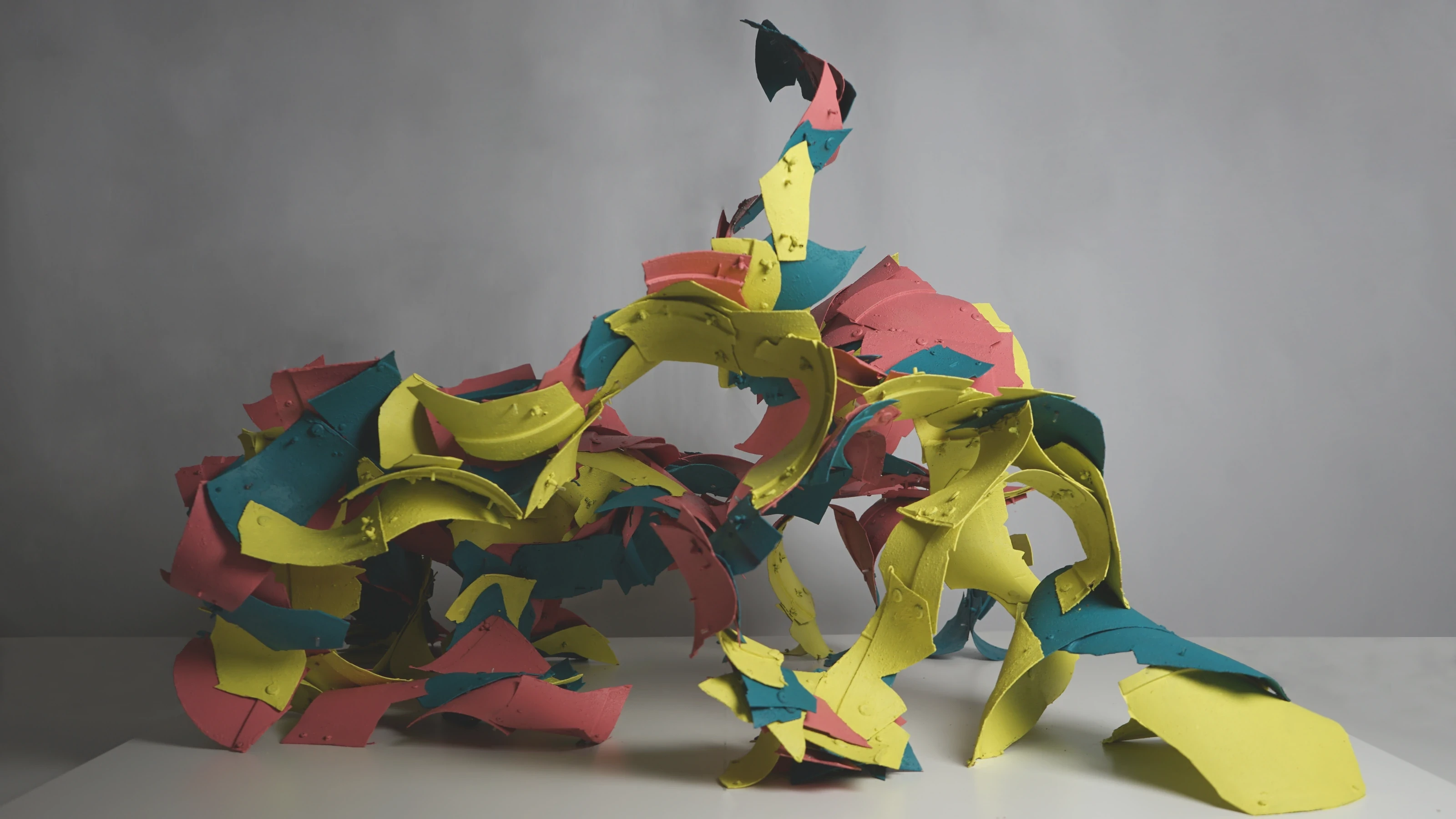
A tall, open shell built from hundreds of curved red, yellow and teal plastic fragments, photographed against a grey wall.

Reform Standard

M.Arch thesis, Greg Lynn Studio, University of Applied Arts Vienna

My M.Arch thesis: a reinforcement-learning agent that designs shell structures from scanned waste fragments, which are then assembled by hand with projected guidance — shown as a solo exhibition at the MAK Vienna in 2020.

Year
2020
Type
Research
Role
Author
Location
Vienna, AT
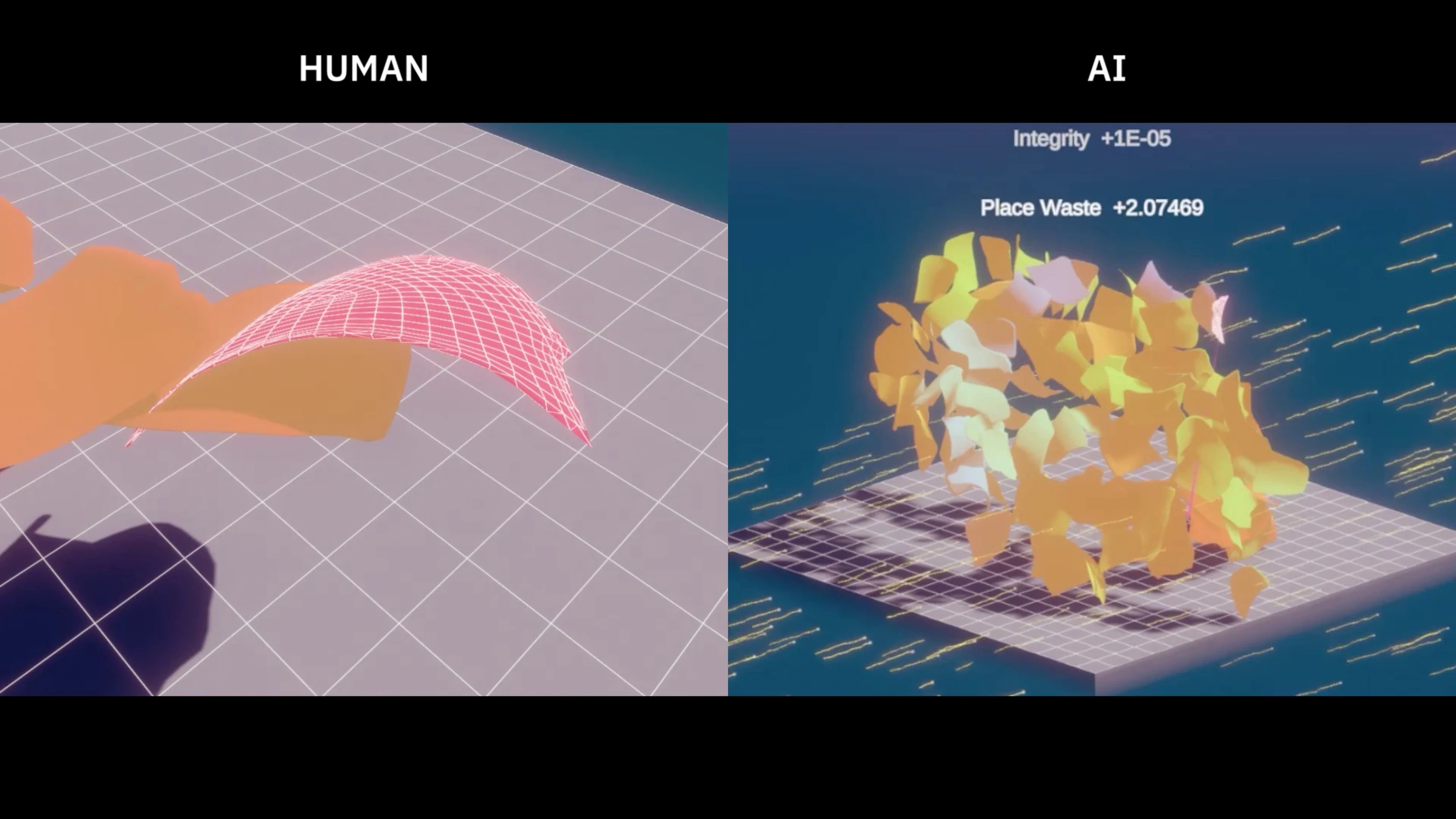
Split screen comparing a human-designed shell (left, a smooth pink surface) with an AI-generated shell (right, a dense heap of orange fragments) on a grid.

Reform Standard is a machine-learning-driven search process that designs new structures from existing waste materials. Using reinforcement learning, machine vision and automated search, it promotes a material-informed design cycle and turns waste into a potential resource.

The project starts by questioning the standardisation practised across industries. Standardisation brings social and economic value through organisational efficiency, but its one-way process — homogeneous inputs, homogeneous processing — also produces growing waste and wasteland. Reform Standard argues that a counter-process, “de-standardisation”, using AI and the search power of computers, can revalue waste and redefine wasteland. Design can then be informed by the material at the very start, with the potential for a better economic cycle and social value.

The project sorts irregular chunks of broken plastic and transforms them into a new form. Instead of recycling them in an energy-intensive process, the engine finds intricacy and a new machine-oriented aesthetic in otherwise neglected waste.

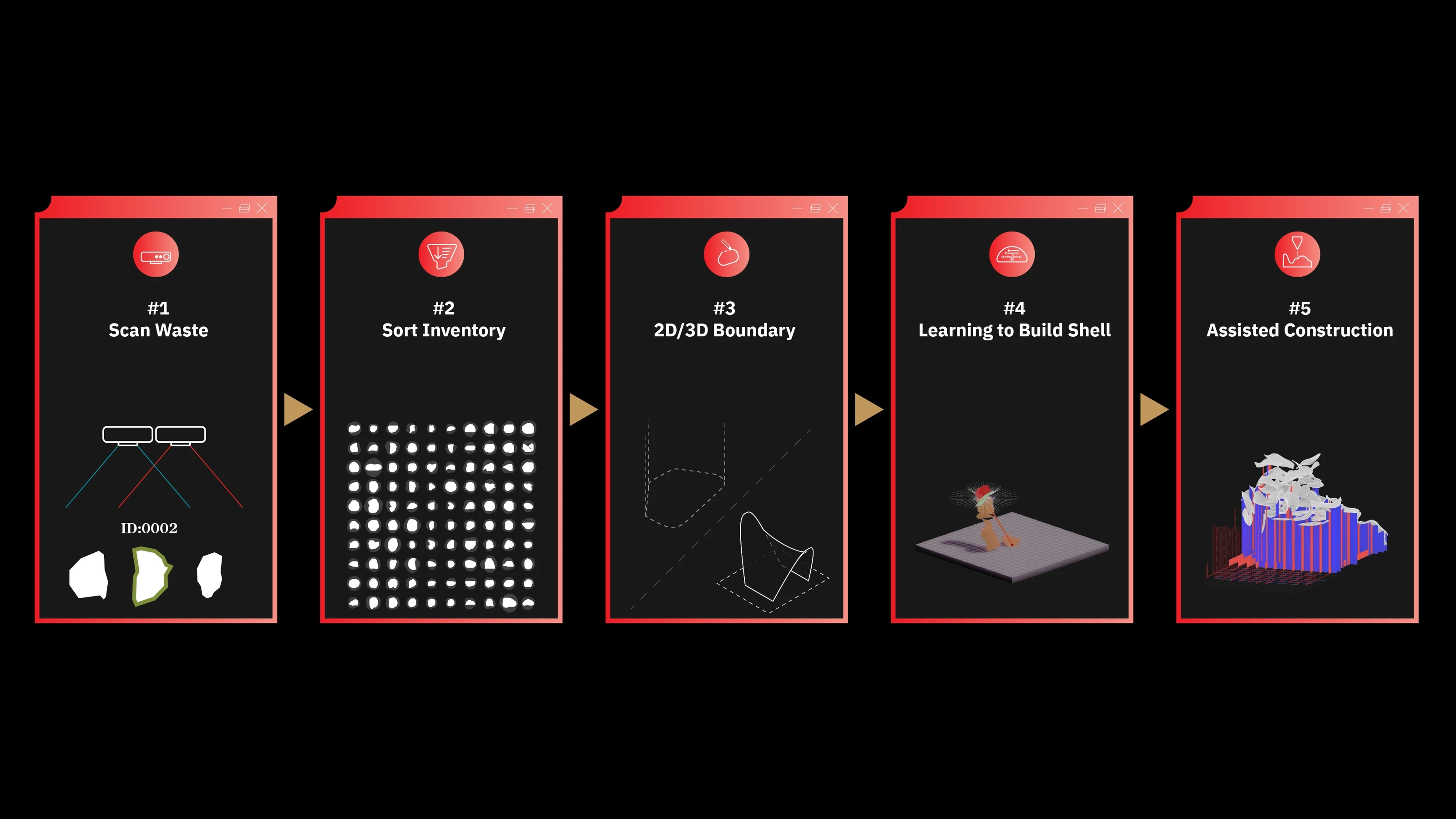
Diagram: three design inputs on the left (scanned geometries of wastes, draw 2D/3D boundary, priority definition) feed a laptop labelled reinforcement learning searching, which outputs fragments’ treatment and construction instructions on the right. A scanned bowl fragment sits on a turntable in front.
01 The system — scanned waste, a drawn boundary and priorities go in; a learned assembly comes out.
Five panels in sequence: 1 Scan Waste, 2 Sort Inventory, 3 2D/3D Boundary, 4 Learning to Build Shell, 5 Assisted Construction.
02 Five steps from waste to shell.
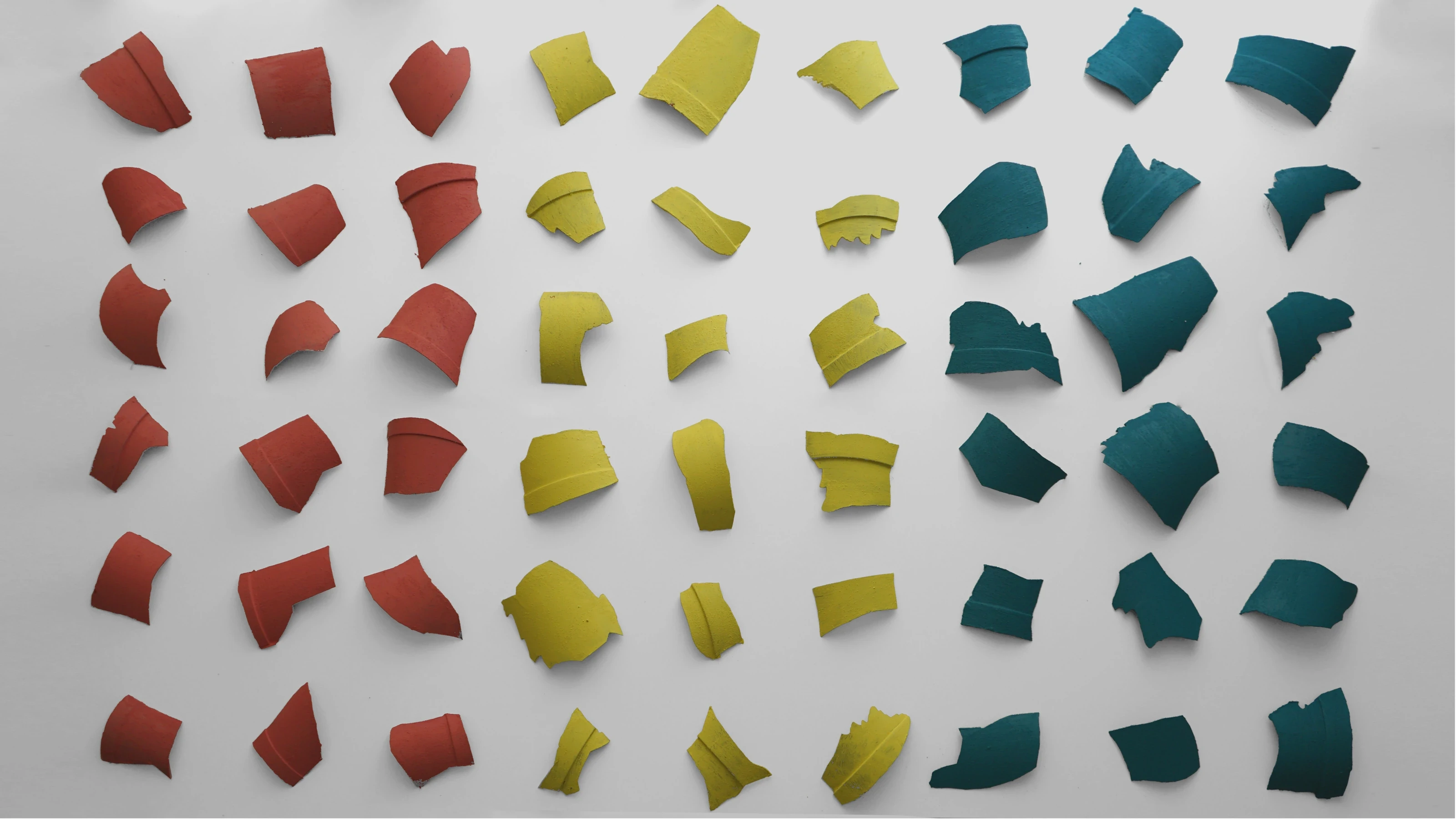
Dozens of curved plastic fragments laid out in rows on a white table, grouped by colour: red, yellow and teal.
03 The sorted inventory — every fragment scanned and catalogued before the agent sees it.
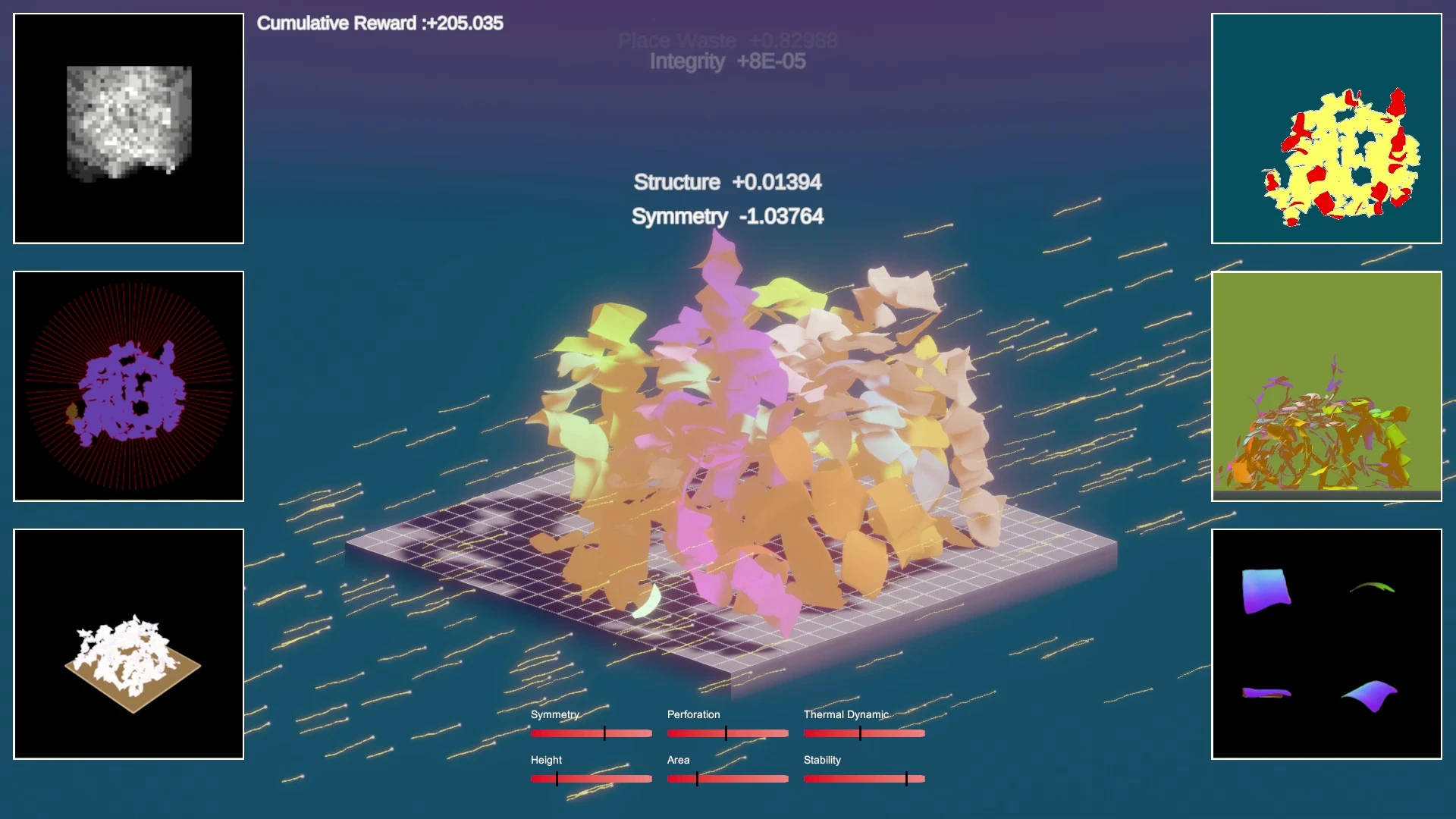
Training interface: a 3D shell of orange fragments on a grid, with cumulative reward, structure and symmetry scores, and three small preview windows on each side.
04 Training in Unity ML-Agents. The agent is rewarded for structure and symmetry.
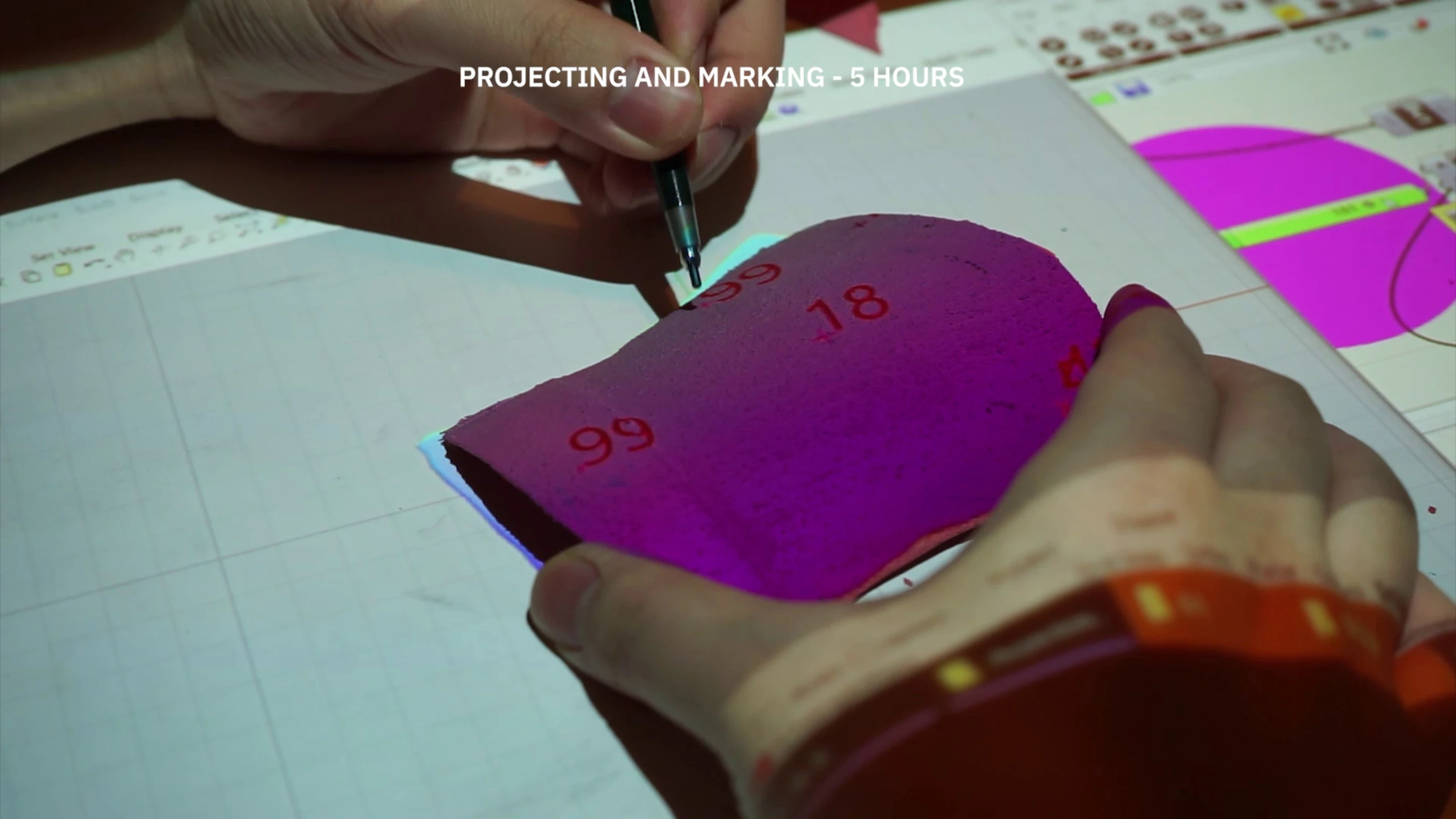
Close-up of two hands marking a pink plastic fragment with a pen; numbers 18 and 99 are projected onto it. Overlay text reads “Projecting and marking — 5 hours”.
05 Assisted construction — the placement of each piece is projected onto it and marked by hand.
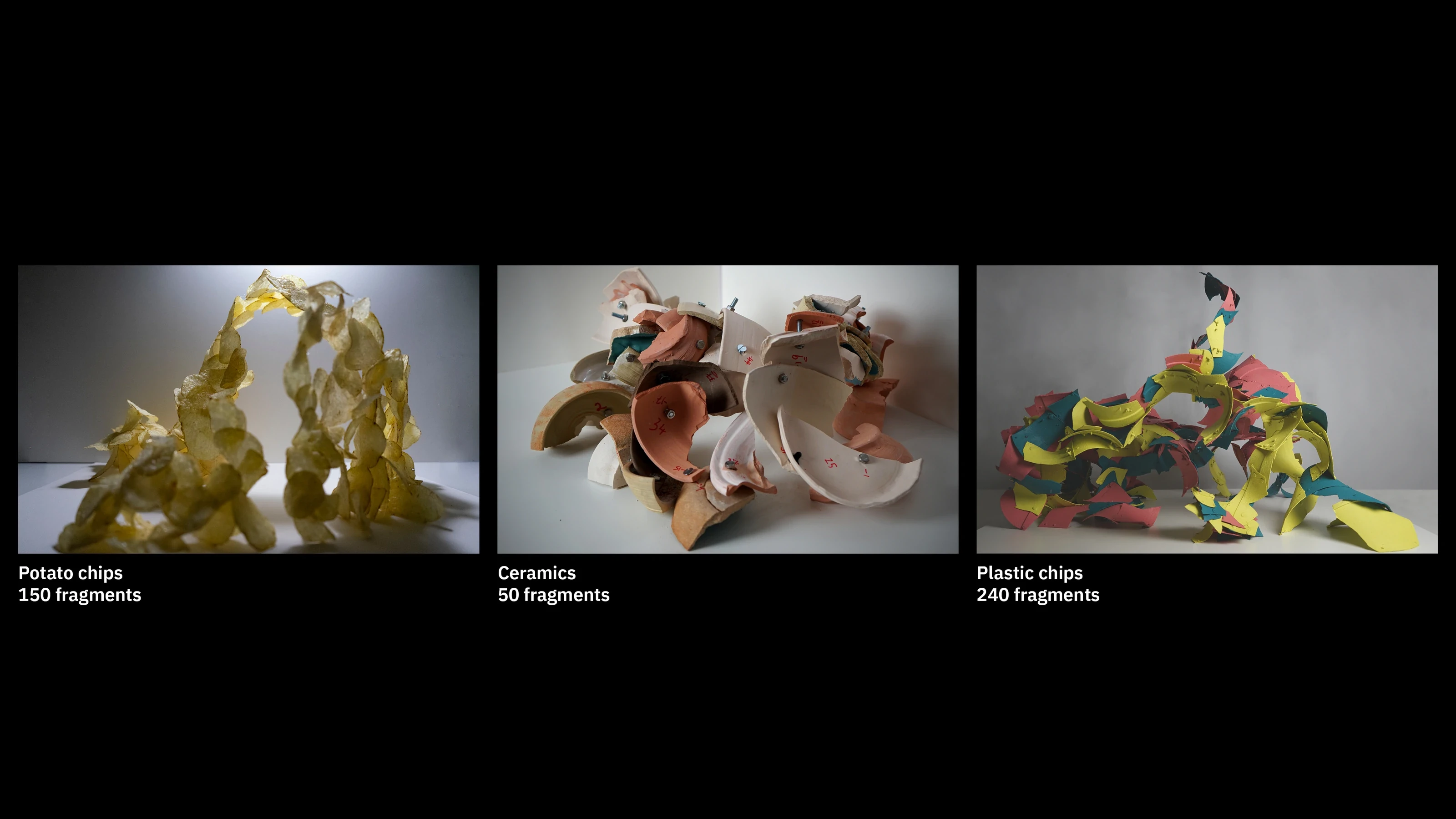
Three shells side by side: potato chips, 150 fragments; ceramics, 50 fragments; plastic chips, 240 fragments.
06 The same process applied to three materials.
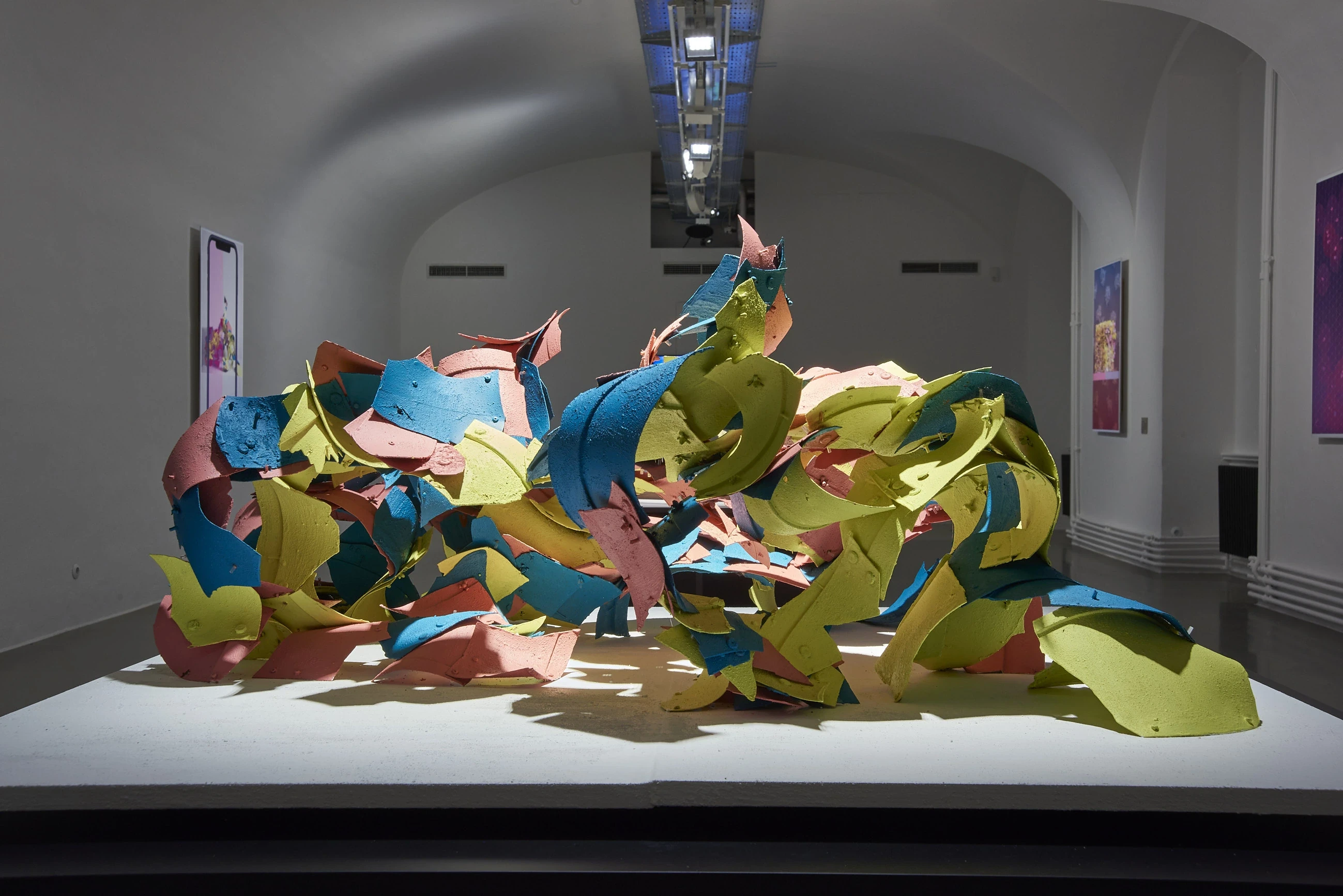
A large shell of colourful plastic fragments on a white plinth in a dim vaulted gallery, with framed posters on the walls.
07 The plastic shell at the MAK, Vienna, 2020. Photo © Georg Mayer / MAK.
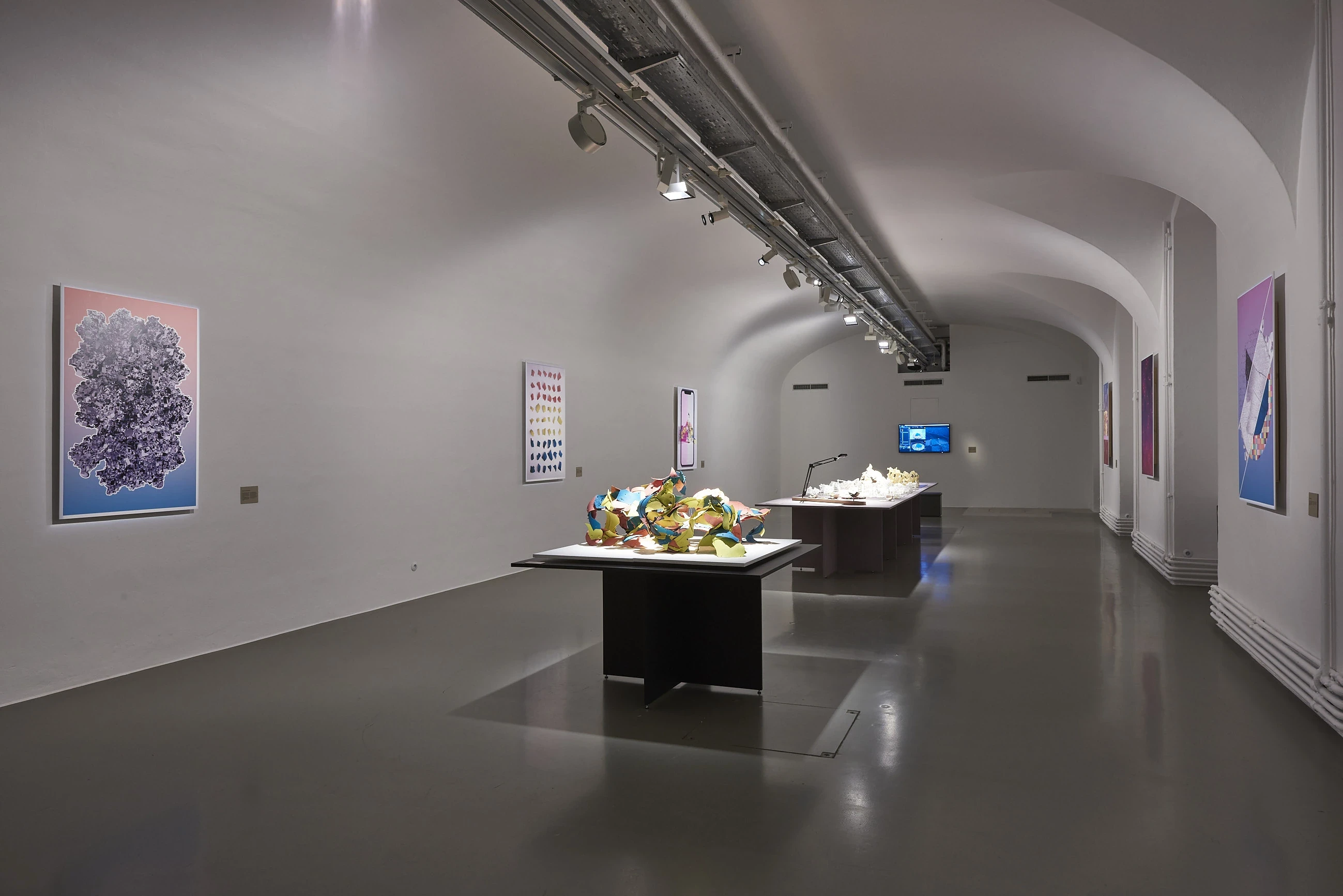
Wide view of the vaulted MAK gallery: plinths with shell models down the centre, posters along both walls.
08 The exhibition, Creative Climate Care. Photo © Georg Mayer / MAK.
A long table of small white shell models; in front, a scanner arm and a fragment on a turntable.
09 The working table — scanning station in front, generated shell models behind. Photo © Georg Mayer / MAK.